Published 2026-06-07 by the Droidwatch Security Research team
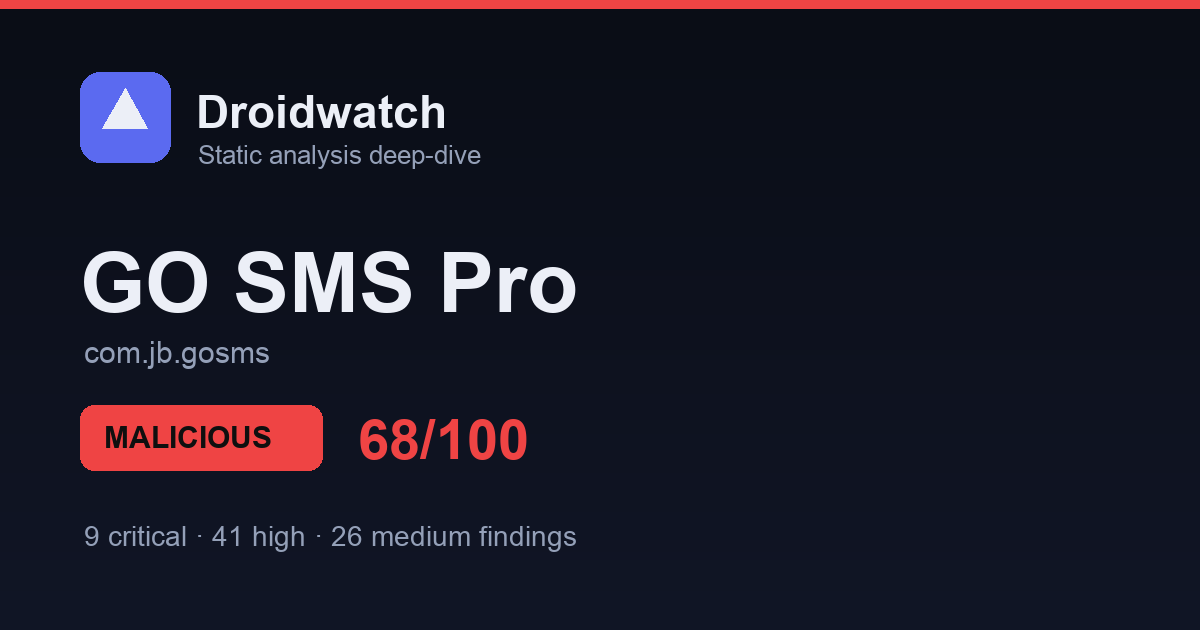
GO SMS Pro (com.jb.gosms) is the most finding-dense sample in the set — Droidwatch counted 9 critical and a striking 41 high findings, for a Malicious 68/100. It declares 18 dangerous permissions, a sprawling attack surface for what presents as a messaging app. The full static teardown is below — unzipped and decompiled, with the app never executed — as one case in our 10-sample static-triage roundup.
Sample at a glance
| Field | Value |
|---|---|
| App label | GO SMS Pro |
| Package | com.jb.gosms |
| Version | 7.10 (code 353) |
| Min / target SDK | 14 / 22 |
| Size | 12.63 MB |
| SHA-256 | 23394c24bb53b7287889e9ac4db5192d3ba4d75d8354312580f2e4bd7f927686 |
| MD5 | 1ef78b157473d6611b02029baa027b5f |
| Verdict | Malicious |
| Risk score | 68 / 100 |
| ML classifier | benign (P(mal)=0.00), model lgbm_binary |
| Findings raised | 86 (9 critical · 41 high · 26 medium) |
The verdict, in the platform's words
'GO SMS Pro' (package: com.jb.gosms, v7.10, SDK 14–22) was analyzed and received a risk score of 68/100 (Malicious). SMS reading + sending permissions combined with SmsManager API references suggest capability to intercept bank OTPs and either forward them silently or relay them to a remote server, fully bypassing SMS-based 2FA. The codebase shows significant obfuscation (score 6/10): single-letter class names and dense reflection use, making static analysis difficult. Dynamic analysis is recommended.
What analysis ran
This was a static pass through Droidwatch's pipeline. The stages below produced findings on this sample (stages that found nothing are omitted):
| Stage | What it inspects | Findings |
|---|---|---|
dataflow |
Source-to-sink data-flow (PII → network/SMS sinks) | 15 |
ipc |
IPC / component-security (exported components, PendingIntents, deep links) | 12 |
rules |
Weighted rule engine (final scoring) | 11 |
manifest |
AndroidManifest: permissions, components, exported surface, deep links | 9 |
jadx |
JADX decompilation deep-scan (secrets, dynamic loading, dangerous calls) | 6 |
malware_classifier |
Malware-family heuristics (stalkerware/ransomware/adware/govspyware) | 5 |
storage |
Insecure data storage (world-readable prefs, external storage, SQLite) | 4 |
attribution |
Build-path / developer / language attribution | 3 |
icc_deep |
Inter-component communication chain analysis | 3 |
banking |
Banking-trojan behavioral signals (overlay, accessibility, device-admin, dropper) | 2 |
strings |
String indicators, obfuscation score, reflection / dynamic-code refs | 2 |
crypto |
Cryptography misuse (weak hashes/ciphers, ECB, insecure RNG, hardcoded keys) | 2 |
packer |
Packers / protectors, anti-analysis and root-detection (APKiD) | 2 |
framework |
Cross-platform framework fingerprinting (Flutter/RN/Unity/native) | 1 |
nsc |
Network Security Config (cleartext, trust anchors) | 1 |
network |
URLs / domains / IPs and high-risk network IOCs | 1 |
certificates |
Code-signing certificate posture | 1 |
yara |
YARA malware-family signature matching | 1 |
native |
Native .so library inspection (JNI bridges, suspicious strings) | 1 |
fake_app |
App Authenticity & Fake App Detection | 1 |
c2_intel |
C2 infrastructure intel (AbuseIPDB, Tor, high-risk geos) | 1 |
fuzzy_hash |
Fuzzy hashing for sample similarity clustering | 1 |
deobfuscation |
Base64 / obfuscated-string decoding | 1 |
Top findings
| Finding | Severity | Category | MASVS / ATT&CK |
|---|---|---|---|
| Banking Trojan — High Behavioral Signal Score | 🟥 Critical | banking | — |
| Data Flow: Device ID (IMEI) → SMS Sending (SMS/OTP Forwarding) | 🟥 Critical | privacy | MASVS-STORAGE-2 |
| Data Flow: SMS Message Content → HTTP Connection (Data Exfiltration) | 🟥 Critical | privacy | MASVS-STORAGE-2 |
| Data Flow: SMS Message Content → SMS Sending (SMS/OTP Forwarding) | 🟥 Critical | privacy | MASVS-STORAGE-2 |
| Data Flow: UI Text Input (possible password) → SMS Sending (SMS/OTP Forwarding) | 🟥 Critical | privacy | MASVS-STORAGE-2 |
| Data Flow: Password Field → HTTP Connection (Data Exfiltration) | 🟥 Critical | privacy | MASVS-STORAGE-2 |
| Data Flow: Device Accounts → HTTP Connection (Data Exfiltration) | 🟥 Critical | privacy | MASVS-STORAGE-2 |
| Data Flow: Device Accounts → SMS Sending (SMS/OTP Forwarding) | 🟥 Critical | privacy | MASVS-STORAGE-2 |
| Data Flow: Device ID (IMEI) → Multipart SMS (SMS/OTP Forwarding) | 🟥 Critical | privacy | MASVS-STORAGE-2 |
| 18 Dangerous Permission(s) Declared | 🟧 High | permissions | MASVS-PLATFORM-1 · T1626 |
| SMS Interception Receiver Registered | 🟧 High | permissions | MASVS-PLATFORM-1 · T1626 |
| Exported Activity Without Permission: GoSmsMainActivity | 🟧 High | ipc | MASVS-PLATFORM-1 · T1416 |
Why this score
The weighted rule engine's top scoring contributions:
| Rule | Severity | Points |
|---|---|---|
| Banking Trojan — High Behavioral Signal Score | critical | +26.4 |
| SMS Interception: Read + Receive + API Refs | high | +17.0 |
| VirusTotal: Suspicious / Low Detection | high | +14.8 |
| Banking Trojan — Moderate Behavioral Signals | high | +11.2 |
| Data Exfiltration: Source-to-Sink Flow via Network | high | +9.8 |
| Boot Persistence: BOOT_COMPLETED Receiver | medium | +6.8 |
MITRE ATT&CK Mobile mapping
| Technique | Tactic | Why |
|---|---|---|
| T1398 Boot or Logon Autostart | Persistence | Registering to execute automatically after device reboot. |
| T1406 Obfuscated Files or Information | Defense Evasion | Using obfuscation to hide malicious code from static analysis. |
| T1412 Capture SMS Messages | Collection | Intercepting SMS messages including banking OTP codes. |
| T1417.002 GUI Input Capture | Collection | Drawing overlays over legitimate apps to capture credentials entered by users. |
| T1422 System Information Discovery | Discovery | Malware author attribution indicators: build paths, certificate identity, langua |
| T1432 Access Contact List | Collection | Collects sensitive PII or device information. |
| T1437 Application Layer Protocol: Web Protocols | Command and Control | Using HTTP/HTTPS for C2 communication. |
| T1521 Encrypted Channel: Asymmetric Cryptography | Command and Control | Weak or broken cryptography that fails to protect data confidentiality. |
| T1533 Data from Local System | Collection | Insecure local data storage exposing credentials and PII. |
| T1575 Native API | Defense Evasion | Malicious behavior implemented in native code to evade Java-level analysis. |
Supply chain
- Third-party SDKs detected: 1 — Google Play Services
- Known CVEs matched (OSV/GHSA): 0
Reproduce it
curl -s -X POST https://droidwatch.app/api/upload \
  -H "X-Upload-Consent: 1" -F "[email protected]" | jq -r .upload_id
# then POST /api/analyze, poll /api/jobs/<id>, read the report (verdict + MITRE + STIX 2.1)
Static-only analysis; the Android dynamic Frida sandbox was not used. Sample from a public 2021 research corpus, referenced by SHA-256. Family attribution is intentionally conservative.